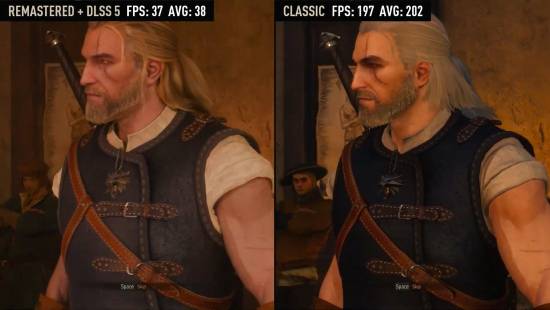
The Witcher 3: Wild Hunt Remastered just got put through its paces with Nvidia's DLSS 5, and the results are a real mixed bag. A tester shared performance and image quality comparisons, and the headline is simple: things look better, but they run a whole lot slower.
First, the numbers. In the same scene, the next-gen version with DLSS 5 enabled holds a steady 68 FPS average, with instantaneous frame rates staying right around there too. Switch to the Remastered version with the exact same DLSS 5 setup, and the average basically gets cut in half — down to 38 FPS, with those instantaneous dips staying low as well. That gap points to the Remastered version's upgraded graphics algorithms and effects demanding a lot more compute.
And it's not just a comparison against the next-gen build. Even inside the Remastered version itself, DLSS 5 takes a toll. In heavy scenes, the Remastered version runs at 42 FPS instantaneous and 46 FPS average without DLSS 5. Turn DLSS 5 on, and those numbers drop to 34 FPS and 38 FPS respectively. The neural image reconstruction model needs to do some serious math, so even though the base internal geometry resolution gets lowered, GPU load still climbs noticeably.
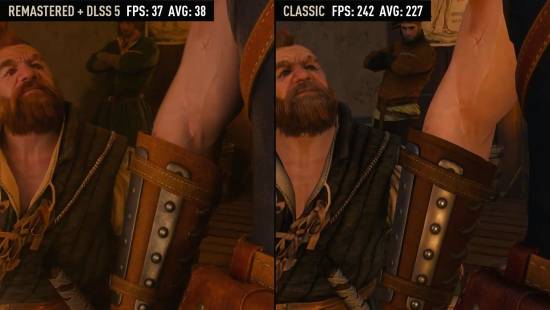
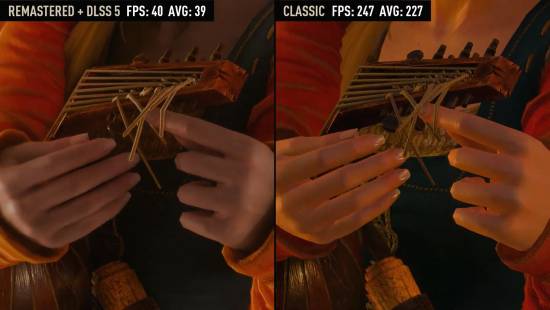
So what do you actually get for that performance hit? According to the test, a pretty visible bump in realism. The algorithm smooths out excessive blur and blown-out highlights, using accurate light scattering and precise self-shadowing to push skin shading much closer to reference quality. Hair, beards, and fine clothing details — including the stitching on leather armor — render with high clarity, free of aliasing and pixel shimmer. The image picks up deeper layering and a more cinematic contrast.
But that extra detail comes at a cost, and the cost is a clear drop in base frame rate. It's the classic trade-off: prettier pixels, fewer of them per second. Whether that's worth it depends on your rig and how much you value that cinematic look over smooth motion.
It's worth noting the Remastered version is available across PC, PS5, NS2, and Xbox Series X|S, so how DLSS 5 behaves will vary depending on your hardware. The test focuses on the PC side, where DLSS 5 is actually in play.
Would you trade half your frame rate for smoother skin and sharper armor stitching? Or is 68 FPS with a slightly softer image the smarter play? Let us know what you'd pick in the comments.
Comments (0)
Log in to join the discussion
Log InNo comments yet