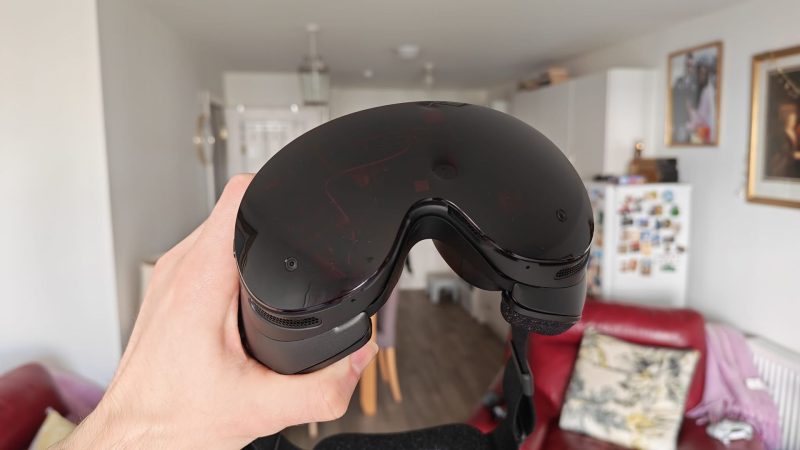
Ever been stuck away from your gaming PC but still desperate to join your friends for a game night? That was me last night. I was at my mum's place in Edinburgh, about an hour from home, with no gaming rig in sight. The closest thing to gaming hardware was an old TV I gave her six years ago and a soundbar from my brother.
But I had plans to play Big Walk with two of my best friends, and getting the three of us together is a scheduling nightmare. I really didn't want to cancel. Luckily, I'm currently testing the Steam Frame, Valve's new VR headset. Remember those old rumours about "Valve Deckard" being like a Steam Deck you wear on your face? That's exactly what I hoped it would be, and this overnight trip was the perfect test.
Around 9pm, I set up in the living room: water on my right, snacks on my left, controller on my lap. After the usual Wi-Fi faff and Bluetooth pairing, I met my friends in Big Walk. The hours flew by. For a game that can make even a PS5 stutter, it ran flawlessly on low settings on the Frame. I did have to plug in after an hour due to battery drain, but otherwise it was a perfect way to play away from home. The controller worked with no latency, and I only adjusted the headset's fit a couple of times. We logged off around 12:30am.
As much as I love VR, this is exactly what I wanted from the Steam Frame. Back when I reviewed PSVR 2, one of my favourite features was Cinematic mode, which turns the headset into an OLED screen for any PS5 game. The Steam Frame might not have Micro-OLED panels or the most powerful processor, but it offers that same big-virtual-screen appeal. Like the Steam Deck, it's not about top specs – it's about home-away-from-home convenience.
I've tested a few non-VR games on it too. The same indies I'd play on a handheld – Towerfall Ascension, Hades – run beautifully, and the controllers have a gamepad mode so you don't need extra peripherals. Demanding AAA games would probably struggle, but that's not the point.
At £899 / $1,059, the Steam Frame isn't cheap. But compared to handheld PCs like the $1,300 Acer Predator Atlas, it starts to feel more reasonable. It's flanked by the $599 Meta Quest 3 and the cheaper 3S, which can do similar things via Virtual Desktop, Xbox Cloud Gaming, or Steam Link. But if you're buying for on-the-go gaming, compare it to a handheld, not a rival VR headset.
One caveat: my night went smoothly because Big Walk has proximity chat. I haven't managed to get Discord running on the Steam Frame yet. That's a glaring absence that will hopefully be fixed soon, and desktop mode isn't the same as on a Steam Deck. I'm still testing the Frame, so I won't spoil my full review. But like PSVR 2's Cinematic mode or Quest 3's Xbox Game Pass streaming, the Steam Frame has excellent secondary uses. With fewer VR games launching these days, this could become the main way some of us use Valve's new headset.
What do you think? Will you be picking up a Steam Frame for portable Steam gaming?
Comments (0)
Log in to join the discussion
Log InNo comments yet