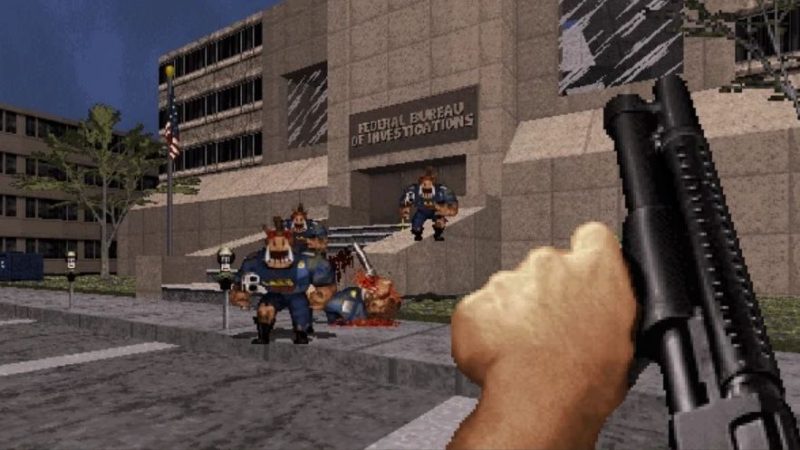
Remember when you could walk into a store and buy a box full of user-made levels for your favorite shooter? In the 1990s, that was a real thing. Level packs for games like Duke Nukem 3D and Quake sat on shelves right next to official expansions, but they existed in a weird gray area between mods and DLC. This digital Wild West era was a breeding ground for future game devs, but it also ended in a lawsuit that changed copyright forever.
Back then, PC gaming had three states: regular games, expansions/DLC, and mods. But level packs were a fourth state—collections of levels sold as boxed products. Some were official, like The Master Levels for Doom 2 or Quake's Scourge of Armagon. Others were unofficial, like the Duke Nukem 3D packs published by Wizardworks. Quality and legality varied wildly. The best came from sanctioned third-party developers like Sunstorm Interactive, who made well-regarded packs like Duke Caribbean: Life's A Beach, Duke It Out in DC, and Duke Xtreme.
Sunstorm was a launchpad for talent. Take Charlie Wiederhold, a college kid obsessed with making maps. He got hired after designing a level for a LAN tournament called the Duke Nukem 3D Rodeo Shootout, attended by industry figures like Randy Pitchford and Richard 'Levelord' Gray. "I got hired by Sunstorm to write an installer for the Duke addon pack they were making," Wiederhold recalls. "I got the chance to do one of the levels for Duke It Out in DC, and [combined with] the installer, I looked around and thought 'why am I still going to college?'"
Wiederhold and one other designer, Robert Travis, built most of the levels for Duke It Out in DC and Duke Caribbean. They also worked on Wanton Destruction for Shadow Warrior, Cryptic Passage for Blood, and Suckin' Grits on Route 66 for Redneck Rampage. All these packs were released in just two years. "It was very Wild West back then," Wiederhold says. "There was no structure to the industry yet. It felt like it was forging into new territory."
For Wiederhold, it was a dream job. "It was definitely some of the most fun [I'd had] as a 20-21 year old, just dreaming about making this stuff," he says. "I['d] put my headphones on, listen to soundtracks and make levels." Sunstorm could crank out so many packs because the Build Engine (used by Duke Nukem 3D) had superior mapping tools. Unlike Doom, where you had to save and load to see your level in 3D, Duke 3D let you fly around in real-time. 3D Realms even provided documentation—a big deal at the time.
But not everyone was so scrupulous. Wizardworks also published dubious packs like Duke Assault, which scraped over 1,500 user-made levels from the internet with no curation. It included unfinished maps and troll levels that killed you on spawn. Even worse, dozens of unauthorized mission packs were boxed and sold, like the infamous Nuke It series from Micro Star Software. These shovelware packs were filled with player-created content, often without permission. This ultimately led to a lawsuit that changed copyright law forever—though the source doesn't specify the outcome, it's a reminder of how the wild early days shaped today's industry.
So, what do you think? Would you buy a box of random user levels today? Or are you glad the Wild West days are over? Let us know in the comments!
Comments (0)
Log in to join the discussion
Log InNo comments yet