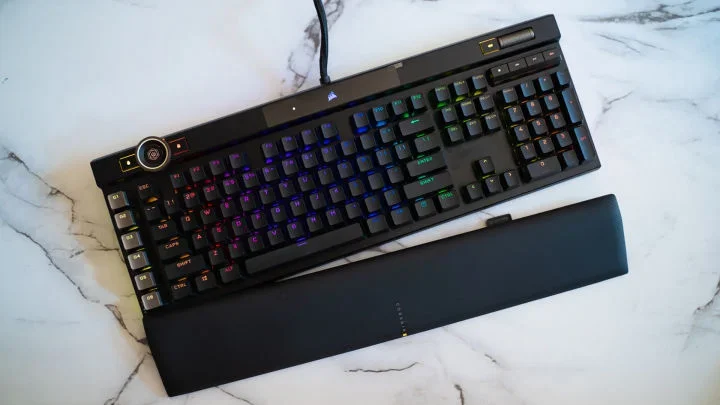
Remember when mechanical keyboards went on a diet? A few years back, ultra-low-profile (ULP) switches were all the rage, promising a slimmer, faster typing experience without sacrificing that satisfying click. The Corsair K100 Air was the poster child for this trend, boasting Cherry MX ULP switches that felt surprisingly good. But then... silence. The industry moved on, leaving these innovative switches in the dust. Why? And more importantly, should they make a comeback?
Let's rewind. The K100 Air was a marvel of engineering. At just 17mm thick, it was one of the slimmest mechanical keyboards ever made. And the secret sauce? Cherry's MX ULP switches. These weren't your average low-profile switches – they used a unique buckling-silk mechanism with a 1.0mm actuation point and a satisfying tactile bump. The result? A typing experience that was both fast and comfortable, with a sound that was more 'thock' than 'clack'. It was a niche product, sure, but for those who tried it, it was love at first keystroke.
So why did ULP switches disappear? It's a classic case of market dynamics. The desktop keyboard world gravitated towards standard and low-profile switches that were already established, with a huge ecosystem of keycaps and mods. ULP switches required specialized keycaps and boards, making them a tough sell for the mass market. Plus, the rise of wireless and compact keyboards pushed manufacturers towards even thinner designs, but they often opted for scissor-switch or membrane solutions to cut costs. The niche appeal of ULP just didn't fit the bottom line.
But here's the thing – the tech was genuinely good. The K100 Air's switches offered a unique blend of portability and mechanical feel that's hard to find today. For gamers and typists who value speed and precision, ULP switches could be a game-changer. Imagine a keyboard that's as thin as a laptop's but with the satisfying feedback of a mechanical. That's the promise ULP held, and it's a promise we've largely forgotten.
Fast forward to 2025, and the keyboard scene is booming with innovation – Hall effect, magnetic switches, and even optical. Yet, no one has really revisited the ULP concept. Maybe it's time for manufacturers to take another look. With advancements in materials and manufacturing, they could address the keycap compatibility issue and bring ULP back in a more accessible form. After all, the demand for slim, portable mechanical keyboards is higher than ever.
So, should Cherry MX ULP switches make a desktop comeback? I'd say absolutely. They offered a unique typing experience that bridged the gap between laptop convenience and desktop performance. If a company like Corsair or Cherry were to release a new ULP board with modern tweaks – better keycaps, wireless, and maybe a hot-swap option – it could carve out a loyal following. The tech deserves a second chance, and I'm not the only one who thinks so.
What do you think? Would you welcome ultra-low-profile mechanical switches back with open arms, or are they a gimmick that's better left in the past? Let us know in the comments!
Comments (0)
Log in to join the discussion
Log InNo comments yet