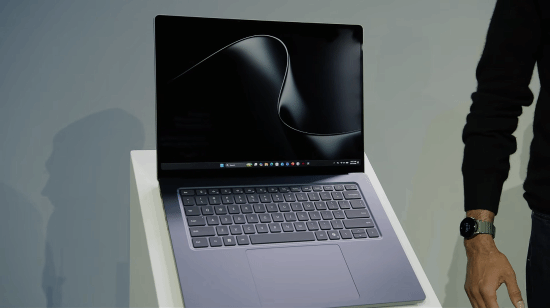
Well, this is one way to shake up the laptop world. Microsoft and NVIDIA have officially pulled back the curtain on the Surface Laptop Ultra, a 15-inch machine built around the new RTX Spark superchip — and the two companies aren't being shy about the hype.
Microsoft is calling it "the most powerful Surface Laptop ever," while NVIDIA CEO Jensen Huang took the stage and declared, "We completely reinvented the personal computer." Big words, sure, but the spec sheet backs up at least some of the swagger. The top-end config packs up to 128GB of unified memory and 1 PetaFLOP of AI compute, which Microsoft says is enough to run a 120-billion-parameter AI model locally. That's the kind of thing that used to require a server rack, not a backpack.
At the heart of it all is RTX Spark, which fuses an NVIDIA Grace Arm CPU with a Blackwell RTX GPU onto a single chip. The full-fat version brings 20 CPU cores and 6,144 CUDA cores, while the base model steps down to 18 cores and 5,120 CUDA cores. Because the CPU and GPU share unified memory, large models can tap into way more capacity than your typical gaming laptop's VRAM. And crucially, RTX Spark supports CUDA natively — so developers don't have to abandon NVIDIA's AI toolchain just because they're on an Arm laptop.
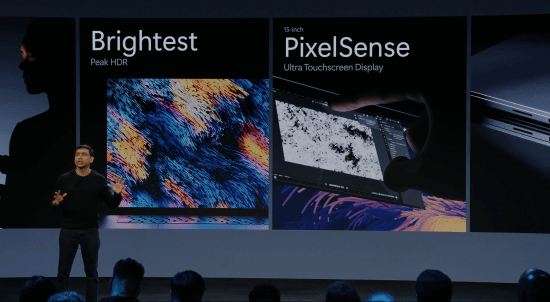
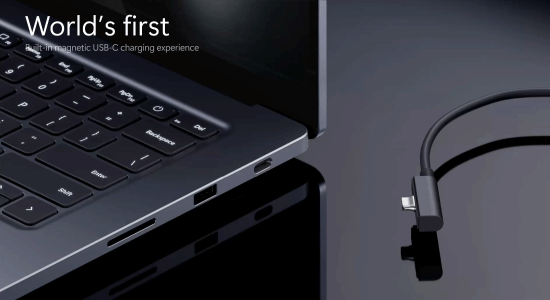
The hardware itself is no slouch either. The chassis comes in under 18mm thick and weighs less than 2.04kg, wrapped around a 15-inch mini-LED PixelSense Ultra touchscreen with a 3:2 aspect ratio, 262 PPI, and a peak HDR brightness of 2,000 nits. Microsoft claims that's the highest HDR peak brightness of any laptop out there. Ports are unusually generous for a Surface: three USB-C, USB-A, HDMI, a full-size SD card reader, and a 3.5mm headphone jack. It's the most port-packed Surface Laptop generation yet, and one of those USB-C ports supports magnetic charging — the charger snaps into place on its own, but the port still works as a regular USB-C when you're not charging.
Since RTX Spark is fundamentally an Arm chip, game compatibility has been the big question mark. Microsoft tried to put those fears to rest on stage by running GitHub Copilot, a DaVinci Resolve render, and Gears of War: E-Day simultaneously — with the game holding a steady 60 frames per second. The company says hundreds of AAA and indie titles will be playable at launch, and that Call of Duty is headed to RTX Spark in 2027. It also showed off a hybrid AI workflow juggling local and cloud models across Blender, Photoshop, ComfyUI, and Unreal Engine, compressing what would normally take days into a few hours.
Against Apple's MacBook Pro M5 Pro, Microsoft is promising 2.1x faster first-token response, 4.3x faster image generation, and 6.2x faster video generation. Fair warning, though: the company didn't share the specific models or parameters used for those benchmarks, so take those numbers with the usual grain of salt.
As for pricing and configurations, the 18-core base model offers 24GB or 32GB of unified memory, while the 20-core version can be specced with 32GB, 48GB, 64GB, or 128GB. Storage runs from 512GB up to 2TB — though the 2TB option is only available with the 64GB memory tier — and the SSD is user-replaceable. The entry 18-core/24GB/512GB setup starts at $2,599.99, the 20-core/32GB/1TB model begins at $3,699.99, and the fully loaded 128GB unified memory version will set you back $5,899.99.
So, is this the Arm laptop that finally makes you ditch x86 for gaming and creative work, or is it a very expensive experiment? Let us know what you think in the comments.
Comments (0)
Log in to join the discussion
Log InNo comments yet