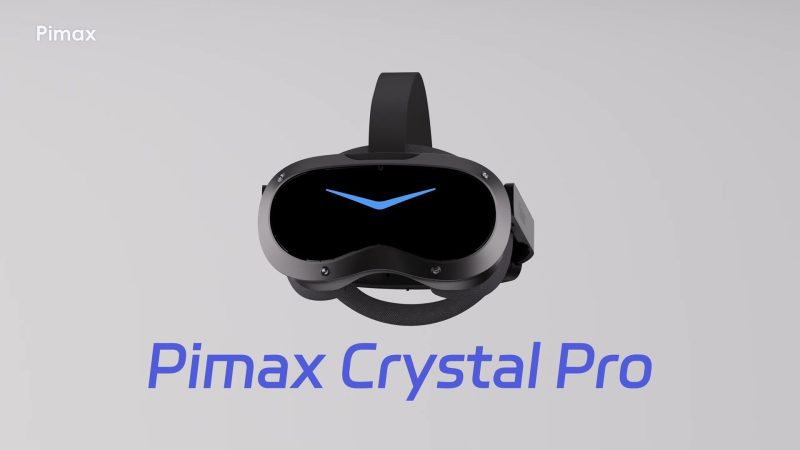
Ever wished your wireless VR headset didn't compress the image? Pimax feels your pain, and its new Crystal Pro headset aims to fix exactly that.
The high-end VR brand has just announced the Pimax Crystal Pro, a standalone headset running on Snapdragon's XR2 Gen 2 processor. It also has a DisplayPort connection for true, lossless PCVR gaming. But the real story here is wireless: Pimax is dead set on solving the wireless VR image compression problem that has plagued every untethered headset.
"Every single wireless headset in the world compresses the image," says Japp Grolleman, brand and communications manager at Pimax. "Each frame gets squished through a codec to fit through wireless connection, and you pay for that squeeze... that's not a flaw of any one product; it's just how wireless VR has always worked. So we asked, what if it didn't have to? That question is the reason this headset exists."
To achieve this, the Crystal Pro uses a dedicated Wi-Fi 6E dongle like Valve's Steam Frame, but with a twist: it utilizes a 60G AirLink, a bandwidth that "nothing else" uses. The trade-off? It won't pass through walls. That's why Pimax offers a $599 AirLink kit with two USB-C antennas that attach to the back of the headset, sending and receiving signals to avoid blockages. Using Pimax Play software, you can tilt and position them for the best connection. Beam aiming via infrared signals ensures the uncompressed signal goes straight to your headset.
On top of that, the Crystal Pro features "native foveated streaming" – a concept Valve coined with the Steam Frame. Using 10 infrared emitters per eye polling at 120Hz, it narrows the focus area to sharpen image quality where it counts. The rest of the specs are equally impressive: 2880 x 2880 QLED panels per eye, 110° FOV, refresh rates up to 120Hz, and aspheric lenses instead of pancake lenses. Pimax says these give more accurate tracking, a cleaner view of your eye, and better viewing angles.
Comfort-wise, you get a separate battery puck you can keep in your pocket (like Apple Vision Pro) and a fixed headband to distribute weight. The magnetic, snapping facial interface and improved SLAM tracking work better in dark surroundings, with different faceplates enabling full-color passthrough or base station tracking. There are three microphones (two for voice, one for noise cancellation), and integrated audio speakers, with Valve Index-like ones sold separately.
The ringless VR controllers are very reminiscent of Valve's Steam Frame controllers – a full gamepad split in half that can snap together magnetically into a traditional gamepad for flat-screen gaming. Pimax is also launching Spation, a desktop-class mini-PC built around VR play, supporting Windows and SteamOS. Pricing? The Crystal Pro will set you back $1,399, or $1,899 with the 60G AirLink kit bundled in. No price yet for Spation.
Pimax even swapped its green and black color scheme for a Valve-reminiscent black and blue, and Grolleman acknowledges the inspiration: "We admire what Valve has built in the same way we admire what the Quest 3 delivers at its price. These two share real common ground." With Valve re-entering the XR market, Pimax is clearly ready to fight for your VR dollars. Will you be picking up the Crystal Pro, or are you waiting to see what Valve brings? Let us know in the comments!
Comments (0)
Log in to join the discussion
Log InNo comments yet