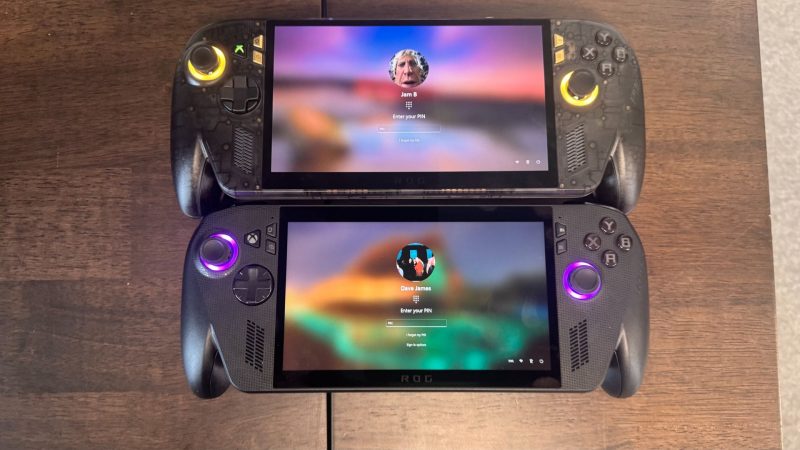
Ever wondered if dropping an extra $300 on a handheld is worth it? That's exactly the question with Asus's new ROG Xbox Ally X20, the 20th-anniversary edition of its Xbox-branded handheld. Compared to the standard Xbox Ally X, the X20 isn't about flashy extras like commemorative faceplates or stickers. Instead, it focuses on meaningful upgrades: a stunning OLED screen, TMR thumbsticks, improved thermals, and MicroSD Express compatibility. You also get Impulse triggers that rumble independently and a D-Pad you can tweak for sharper or softer corners.
The screen is the headline act. The X20 packs a 7.4-inch OLED display with 1400 nits peak brightness and HDR certification. In our review, it was so bright that looking at the sun in Cyberpunk 2077 while lying in bed actually made us wince. The standard Xbox Ally X has a 7-inch IPS LCD with only 500 nits. Both share the same 1920 x 1080 resolution and 120Hz refresh rate, but the OLED's contrast and brightness are a game-changer.
Under the hood, both handhelds are identical. They run on the AMD Ryzen Z2 Extreme with Zen 5 / Zen 5c cores, 8 cores / 16 threads, and a 5 GHz boost clock. The GPU is RDNA 3.5 with 1024 shaders and a 2.9 GHz boost. You get 24 GB of LPDDR5X RAM and 1 TB of PCIe 4.0 NVMe storage on both. So performance should be neck and neck.
The differences are in the details. The X20 has TMR (tunnel magnetoresistance) thumbsticks, which are more durable and precise than traditional Hall effect sticks. It also has improved thermals, meaning it should run cooler and quieter. And it supports MicroSD Express cards, which are faster than standard UHS-II microSD. The X20 is slightly heavier at 756g vs 715g, and a bit thicker too. Battery remains 80 Wh on both.
Connectivity is largely the same: USB4 Type-C with DisplayPort 2.1 and Power Delivery 3.0, plus USB 3.2 Gen 2, a 3.5mm jack, and a microSD reader. The X20's reader supports the faster Express standard. Price is the big divider: the X20 costs $1,300 / £1,300, while the Xbox Ally X is $1,000 / £900. That's a hefty premium for an OLED screen and a few extras.
So, is it worth it? If you crave the best visuals and don't mind paying for them, the X20's screen is genuinely impressive. But if you're on a budget, the standard Xbox Ally X offers the same performance for $300 less. What do you think—will you be picking up the X20, or sticking with the original?
Comments (0)
Log in to join the discussion
Log InNo comments yet