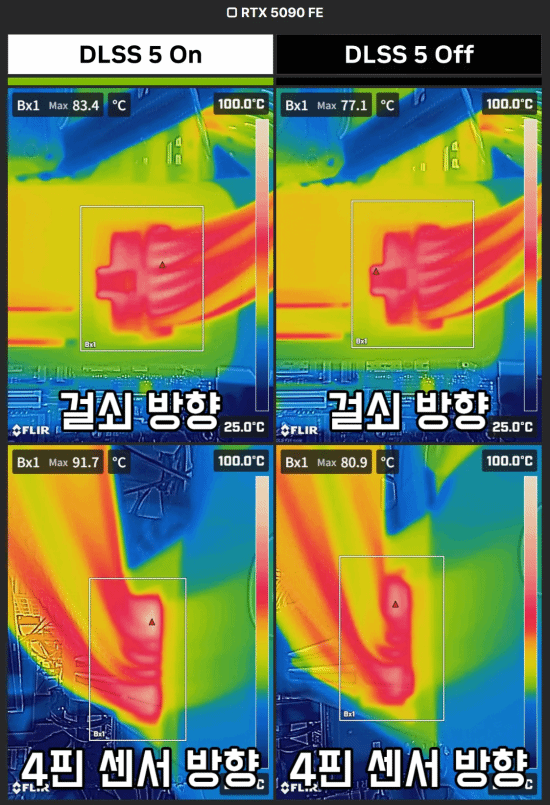
DLSS 5 might be a visual treat, but it's turning up the heat on the RTX 5090 in a very literal way. A new test from Korean outlet QuasarZone found that the card's 16-pin power connector gets hotter than the GPU core itself when the neural rendering tech is enabled—and we're talking melt-your-cable hot.
Instead of the usual frame rate and image quality benchmarks, QuasarZone went straight for the scary stuff: power draw, GPU temps, and the temperature of that infamous 16-pin connector. They fired up Cyberpunk 2077 at 4K with DLSS Quality and Ultra presets, ran it for 20 minutes straight, and kept the room at a steady 27.5°C.
The results are eye-opening. With DLSS 5 on, the RTX 5090 Founders Edition's 12V-2x6 connector hit 91.7°C on the sense-pin side, up from 80.9°C. The latch side climbed from 77.1°C to 83.4°C. Meanwhile, the GPU core averaged 83.0°C with a peak of 86.3°C. Yep—the power connector is now the hottest part of the card.
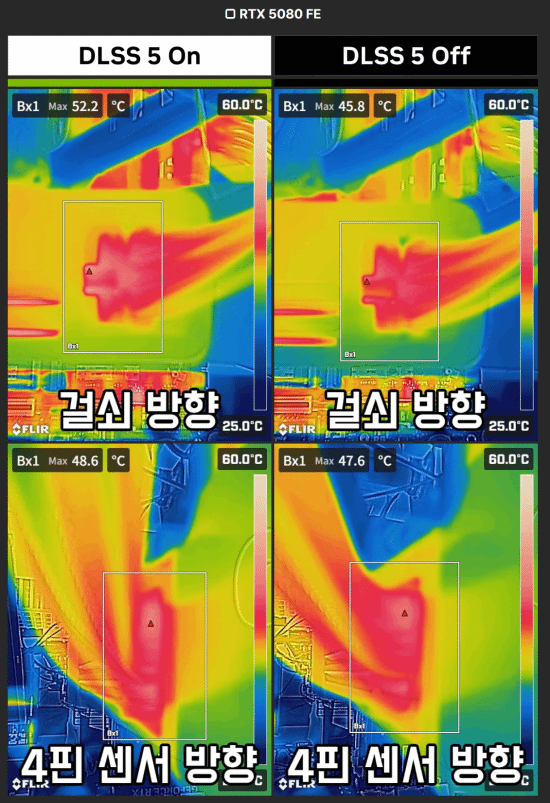
For comparison, the RTX 5080 FE stayed relatively chill. Its connector only reached 48.6°C and 52.2°C in the same test, a much smaller jump than the 5090's. So if you're running a 5080, you can breathe a little easier.
Power draw tells a similar story. HWiNFO logged the RTX 5090's average power jumping from 509.2W to 575.1W—right up against its 575W power limit. The RTX 5080 went from 298.2W to 350.3W, also nearing its 360W cap. External PCAT measurements, which catch transient spikes, were even higher: the 5090's total system power averaged 593.9W with a peak of 658.0W. Just the 16-pin input alone averaged 582.7W and peaked at a whopping 646.7W.
Using an ASUS ROG Astral RTX 5090 (limited to 575W), QuasarZone also checked individual pin currents. Without DLSS 5, the six pins carried between 6.94A and 7.47A. With DLSS 5, that rose to 7.83A–8.51A. None exceeded the 9.2A spec limit, but a 0.7A spread between the highest and lowest pins shows current isn't perfectly balanced.
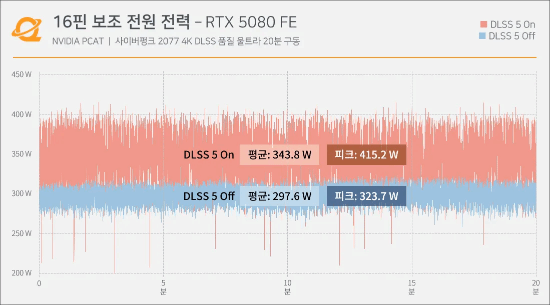
The real nightmare scenario? The test simulated one pin failing due to wear or poor contact. Without DLSS 5, the highest pin would hit about 8.9A—still safe. But with DLSS 5, that same pin would be forced to carry around 10.1A, blowing past the 9.2A limit. That's exactly the kind of situation that can lead to melted connectors.
So if you're planning to crank DLSS 5 on your RTX 5090, make sure your 12V-2x6 cable is fully seated, undamaged, and ideally monitored. The performance boost might be impressive, but the heat is no joke. Have you checked your connector temps lately? Let us know in the comments.
Comments (0)
Log in to join the discussion
Log InNo comments yet