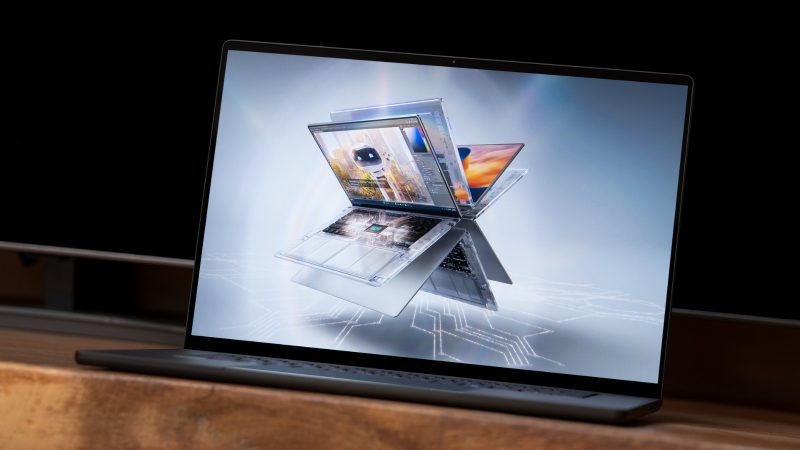
Ever wondered if an Arm-based laptop could actually handle your favorite AAA games? NVIDIA's new RTX Spark superchip just made its laptop debut, and we got our hands on the ASUS ProArt P16 to find out if this Windows on Arm machine lives up to the hype.
The RTX Spark N1X is essentially the same GB10 Grace Blackwell superchip found in NVIDIA's DGX Spark mini workstation. It pairs a Blackwell GPU built on TSMC's 3nm process—with 48 SMs and 6,144 CUDA cores, matching the desktop RTX 5070—with a 20-core Arm CPU designed in collaboration with MediaTek. There's also a 256-bit unified memory interface supporting up to 128GB of LPDDR5x at 9400 MT/s, delivering 300.8 GB/s of bandwidth. The GPU and CPU tiles are linked via NVLink-C2C with 600 GB/s bidirectional bandwidth, which is 25x more energy-efficient and 90x smaller than PCIe 5.0.
NVIDIA worked closely with Microsoft to optimize Windows 11 on Arm for this platform. The result? Better task scheduling, dynamic power and thermal management, and improved unified memory handling—you can even adjust how much VRAM is allocated to the GPU (our 64GB test unit defaults to 30.5GB). Plus, native Arm apps like Blender, DaVinci Resolve, Affinity, and Adobe Photoshop now run with full RTX GPU acceleration, while Prism emulation keeps older x86 software and games running smoothly.
The ASUS ProArt P16 H7607 packs 64GB of unified memory, a 1TB PCIe 4.0 SSD, a 16-inch 3K 120Hz OLED display, and a 99.9Wh battery into a 12.9mm, 1.77kg chassis. It also offers three USB4 Type-C ports, USB 3.2 Type-A, HDMI 2.1, and an SD Express 7.0 reader. The 140W USB-C power adapter does occupy one of those USB4 ports while charging, though.
So how does it game? Surprisingly well. Most AAA titles run stably on the RTX Spark platform. At 1440p with ray/path tracing, DLSS quality mode, and 6x frame generation, many games hit over 120 fps. Even demanding titles like PRAGMATA and Resident Evil Requiem with path tracing and 4x frame gen reach nearly 90 fps. At 4K, most heavy ray-traced games still hold 60 fps with 6x frame gen, while 4x frame gen titles dip to around 53 fps. NBA 2K27 with DLSS 5's neural rendering model is a standout—nearly 150 fps at 1440p and close to 100 fps at 4K.
However, at 1080p, CPU bottlenecks become more noticeable, especially for x86 games running through Prism emulation. Titles like Black Myth: Wukong and CS2 don't perform as well as they would on x86 hardware. We also hit launch issues with four games: Rainbow Six Siege (anti-cheat failure), Battlefield 6 and F125 (x64 CPU requirement), and Red Dead Redemption 2 (VRAM misdetection).
CPU performance is solid for content creation. In native Arm apps like Cinebench 2026 and Blender 5, the RTX Spark N1X closely trails the Intel Core Ultra 5 250K Plus and even beats it in Geekbench 7. Only V-Ray 6 CPU lags slightly behind the Ryzen 5 9600X, likely due to optimization. AI tasks are where the unified memory shines—with 30.5GB VRAM, you can run large local models comfortably. For example, an 8-billion-parameter Qwen 3 model handled a 14,000-token context window, and a 4-billion-parameter Flux 2 Klein model generated nearly 37 images per minute.
The biggest advantage here is the unified memory architecture—you can manually adjust VRAM allocation based on your workload. Gaming or video editing? Give more memory to the system for multitasking. AI rendering? Crank up VRAM for faster results. Sure, the price is steep thanks to rising memory costs, but for a thin, light laptop that handles gaming, creation, and AI workloads this well, calling it the ultimate AI PC feels justified.
What do you think? Will you be picking up an RTX Spark laptop, or are you waiting for better game compatibility? Let us know in the comments!
Comments (0)
Log in to join the discussion
Log InNo comments yet