
DLSS 5 isn't even out yet, but someone's already crammed it into Control Resonant — and the results are equal parts jaw-dropping and terrifying for your GPU.
A new deep-dive from GameGPU manually deployed the leaked neural rendering tech across the entire RTX 30-to-50 series stack, from the RTX 3060 all the way up to the RTX 5090. They ran the game at max ray tracing to see exactly what DLSS 5 does to image quality, frame rates, and latency. Fair warning: this is all unofficial, fan-driven tinkering with leaked software, so take everything with a grain of salt until Nvidia actually ships the thing.
So what is DLSS 5? Unlike DLSS 2's upscaling or DLSS 3's frame generation, it's a completely separate AI rendering architecture. It reads the game's underlying models, depth of field, and lighting data directly, then rebuilds every single frame from scratch — generating hyper-realistic textures, micro-geometry, and true light scattering. In theory, it pushes visuals closer to film-grade realism than anything we've seen in a game before.
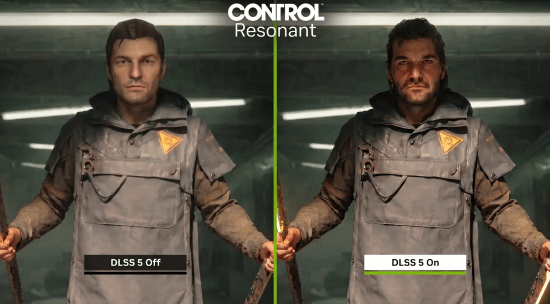
Here's the catch: Control Resonant doesn't support DLSS 5 natively, and its anti-tamper systems block standard Reshade injection. GameGPU had to use DLSS 5 Swapper paired with a custom OptiScaler backend, manually tweaking parameters, enabling neural rendering, and maxing out the game's native ray tracing just to avoid artifacts and flickering. Not exactly a plug-and-play experience.
When it works, though, the difference is night and day. Under traditional rendering, character skin looks flat and stiff, hair and clothing textures are bland, and metal or wet surfaces have that telltale pixelated shimmer. With DLSS 5 on, you can see pores and veins on a character's face, individual strands of hair, the weave in fabric. Puddle ripples and micro-cracks in metal pop with detail, and screen reflections stop flickering entirely. The whole image sheds that "3D game" look and edges toward photorealism.
But that fidelity comes at a brutal cost. GameGPU measured roughly 3ms of fixed latency per frame with DLSS 5 active, plus noticeable frame drops and increased input lag in dynamic scenes. It's the classic image-quality-versus-performance trade-off, and even stacking DLSS Quality mode on top doesn't rescue the frame rate.
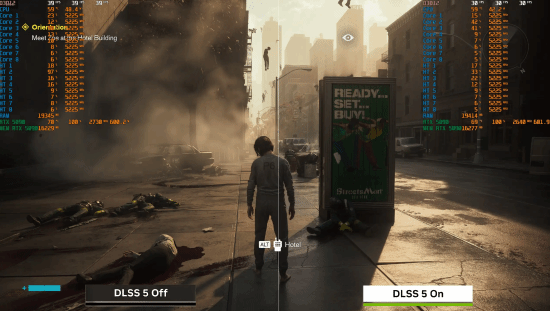
The numbers are rough. At 1080p with max ray tracing, only flagship cards like the RTX 4090 and RTX 5090 hold a stable 60fps. At 1440p, even the RTX 5090 barely scrapes the 60fps line. And at 4K? No GPU can hit a stable 60fps, DLSS 5 or not — the RTX 5090 manages only around 45fps on average. Mid-range cards drop below 30fps with DLSS 5 enabled, which means the game looks pretty but plays like a slideshow.
Control Resonant is available on PC, PS5, and Xbox Series X|S. Would you sacrifice half your frame rate for that level of visual fidelity, or is 60fps non-negotiable? Let us know in the comments.
Comments (0)
Log in to join the discussion
Log InNo comments yet