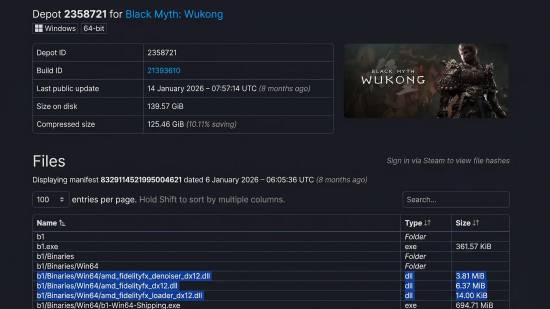
Black Myth: Wukong fans are doing what they do best: digging through game files and finding something interesting. This time, it's a set of AMD FidelityFX components that have popped up in the game's SteamDB database, and the community is already buzzing about what it could mean.
The discovery centers on the game's b1-Win64-Shipping executable structure, where players spotted several dynamic link library files: amd_fidelityfx_denoiser_dx12.dll, amd_fidelityfx_dx12.dll, and amd_fidelityfx_loader_dx12.dll. If those names mean nothing to you, here's the short version: they're tied to AMD's ray reconstruction and advanced denoising tech, the kind of stuff that makes reflections look sharper and more detailed without completely tanking your GPU.
Naturally, the speculation train left the station immediately. Some players believe Game Science is actively testing ray regeneration technology, or perhaps prepping an updated ray-tracing plugin for Unreal Engine 5. The appeal is obvious: neural-network-based denoising algorithms could deliver cleaner reflections and finer detail while keeping performance overhead manageable. For a game as visually ambitious as Black Myth: Wukong, that's an exciting prospect.

But not everyone is ready to light incense at the altar of ray tracing just yet. Plenty of community members are pumping the brakes, pointing out that shipping a full SDK package inside a project is pretty standard practice. These library files often get bundled in as inactive companion code, sitting there quietly without ever being switched on. Their go-to example? NBA 2K27, which technically includes a RadianceCache.dll file but doesn't actually enable ray tracing. So yeah, a file existing in the build doesn't automatically mean it's doing anything.
That said, the timing is interesting. Black Myth: Wukong has been a massive success across PC, PS5, and Xbox Series X|S, and Game Science has a history of supporting the game post-launch. Whether these AMD FidelityFX files are a breadcrumb for a future update or just leftover packaging, only the developers know for sure. Until then, the community will keep digging and debating.

What do you think? Are these files a sign of ray tracing upgrades on the horizon, or just another case of code that never gets out of bed? Let us know in the comments.
Comments (0)
Log in to join the discussion
Log InNo comments yet