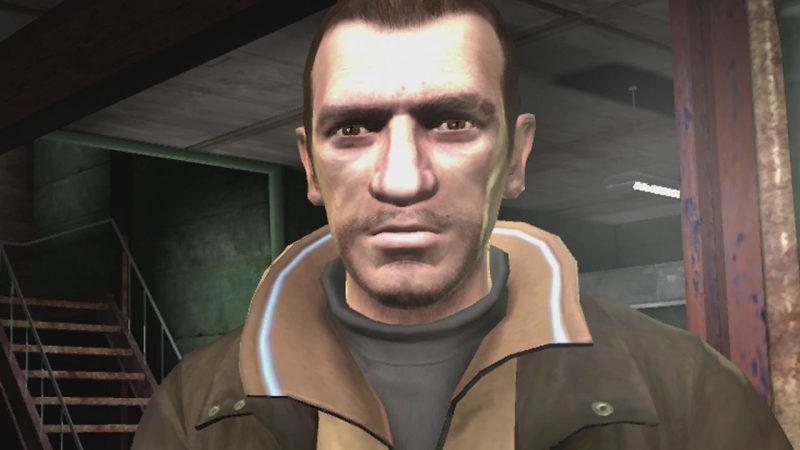
I’m taking a look back at each of the core Grand Theft Auto games and replaying them in the lead-up to the arrival of Grand Theft Auto 6. What we’ll be putting together won’t be traditional re-reviews, and they won’t come with any new IGN score, but they will re-examine what made each GTA remarkable upon the time of its release. By the end of the project, using GTA’s previously six-star wanted level, you should be able to get an idea of where each of these games roughly rank in my long-term love for this series. Today it’s time to revisit Liberty City in Grand Theft Auto IV. Grand Theft Auto IV is smaller than GTA: San Andreas. Significantly so, if you exclude water, as its land area is reportedly around only one-quarter the size of San Andreas’s physical real estate. GTA IV also has markedly reduced vehicle variety, with much fewer of them overall and zero car customisation. It has no asset management, less mission variety, no RPG-inspired skill system, a pretty paltry list of cheats, and the only thing you can alter about lead character Niko Bellic is his outfit. In fact, if you weren’t around for the arrival of GTA IV, I think it’s fair enough that you may actually find yourself a little confused about its place in the series pantheon. That is, how could this apparently smaller game with overtly fewer features than its predecessor have instantly become not only the highest-rated GTA in the history of the series, but one of the highest rated games of all time, full stop? Well, the devil is in the details. Countless, unprecedented, incredible details. For all his faults as an Eastern European war veteran with a shady past and a short temper, who may or may not have spent 106 minutes trying to kill Owen Wilson back in 2001, Niko Bellic has actually carved out a place as one of the most likeable and accessible characters in the franchise. Lured by his cousin Roman’s lies of wealth and opportunity, it’s easy to both sympathise with Niko’s disappointment at his first encounter with the American Dream, and share in his distaste for the various bastards of Liberty City who seek to exploit him. Released in 2008, GTA IV was the first game in the series to be set in the present day since GTA III. In 2026, it’s an interesting snapshot of the world just prior to the smartphone takeover – back when the internet was still a destination you took time out to visit on a computer, social media was still a novelty rather than the worst thing to happen to humanity since disco music, and your radio would always let you know you were about to receive a mobile phone call. However, despite the 18 year gulf between its setting and today, GTA IV doesn’t feel remotely as retro as something like GTA: Vice City did in 2002 – even though there were only 16 years between its setting and the time of its release. The aesthetic distinctions between the ’80s and 2000s are, of course, profound. What are the visual differences between the 2000s and now, other than the fact The Rock used to have hair? It’s not a long list. Monoculture is dead, fashion is looping, and – as remarkably detailed as GTA IV is – I don’t think there’s anything Rockstar could have done to dodge this phenomenon, Dwayne Johnson’s shaven skull notwithstanding. Flashing Lights However, even though the feeling I glean from GTA IV being a depiction of a specific moment in time may not be as strong as that elicited by either GTA: Vice City or GTA: San Andreas, there is no denying what a victory it is in terms of its capacity to represent a true sense of place . GTA IV’s Liberty City wasn’t just one of the most convincing virtual cities of its generation; I honestly don’t think it’s an overstatement to say its commitment to tiny details still stands up to scrutiny today. Revisiting GTA IV’s Liberty City in 2026 – a game that my Xbox 360 play data indicated to me I haven’t touched in around 14 years – I’m immediately reminded of how fastidiously crafted every corner of this world is. Yes, it’s a smaller environment than that of San Andreas, but it’s one that is so much more crowded, dense, and dripping with depth. It’s more immediate, more authentic, and more intimate than anything that came before it – and it’s still a more credible and convincing city than those in most of the open-world action games I’ve played since. It’s still a more credible and convincing city than those in most of the open-world action games I’ve played since. Strolling though Star Junction – Liberty City’s glitzy Times Square proxy – I find myself in tourist mode. I’m too engaged by the fact there’s something to see, read, or admire everywhere I point the camera to be distracted by the temptation of causing anti-social chaos. Hoofing it through Hove Beach – inspired by Brooklyn’s Brighton Beach – and I’m once again impressed at how much mileage Rockstar extracts from the seemingly mundane. Garbage strewn on the sidewalks. Individualised storefronts that are faithful to the demographics of the area and are never repeated elsewhere around the city. Places with stories you’ll never get to the bottom of. Like, who is Mikey Pissroll, and how much better at pool is he than Anal Alan? The architecture, the lighting, the lived-in grime; Liberty City here feels more than real. It feels aged . Rockstar didn’t just build streets; it built them, and then assaulted that asphalt with decades of simulated wear. As a result, those streets are a patchwork of potholes, road plates, and sporadic strips of more recently re-surfaced segments. The custom signwork, the bespoke graffiti – the fact that no piece of the city looks like any other. A multitude of elements combine to create what was an unprecedented sense of immersion at the time, and absolutely still holds up today. Sure, there’s an unavoidable murkiness to playing GTA IV on original hardware like the Xbox 360, where you’re obviously beholden to the resolution limitations of its age. It results in a soft and rather muted image, and one that’
Comments (0)
Log in to join the discussion
Log InNo comments yet