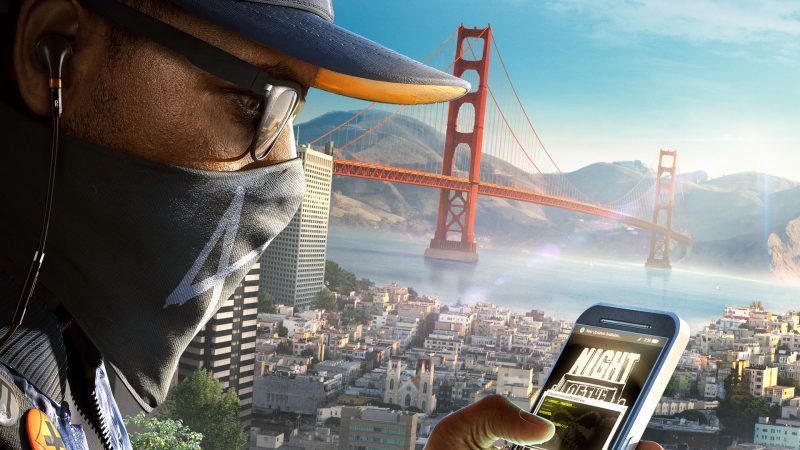
Any job worth doing in Watch Dogs 2 is worth doing to music. And so, the best mechanic in Ubisoft's hacker-action sequel is Marcus Holloway's earbuds. Equippable at any time, they pump an eclectic stream of on-demand tunes, from Dizzee Rascal to Anti-Flag, KC & The Sunshine Band to Run The Jewels and more, into your ears. You can freely soundtrack any mission (attempting grand larceny while blaring Mozart's Eine Kleine Nachtmusik is one moment we won't forget in a hurry) or simply wander the streets of San Francisco to your favourite songs. One particular track so perfectly captures the philosophy of Watch Dogs 2, it almost feels as if the game was formed around it. We blast Get Stupid as we have Holloway ride on top of a car like it's a skateboard, driving it remotely via his phone. "Get stupid, it's what we do good," Mac Dre raps. "Ghost ride the whip while we dancin' on the hood." Virtual Californians look on in bewilderment, and we laugh uproariously. Even Dre seems to admire our efforts, crooning his approval: "Boy, we go dumb, dude". Credit to Ubisoft, then, for a tonal U-turn of such epic proportions that it singlehandedly saved a series. Watch Dogs got stupid. And it worked. Bright lights of play (Image credit: Ubisoft) After the 2014 release of Watch Dogs, something had to be done. It suffered as a result of a now-infamous E3 2012 reveal that, on the cusp of a new generation of consoles, made promises beyond the actual graphical capabilities. The ‘downgrade', as it was dubbed, was apparent to anyone playing the final game. But on top of that, Watch Dogs didn't endear itself to players. Its Chicago setting was designed to be cramped and dark, a representation of a city riddled with surveillance cameras and made paranoid under the all-seeing eye of Big Tech. And its lead, Aiden Pearce, had all the charisma of wet cardboard. Sunny San Francisco is a breath of fresh air in comparison. It's a riot of colour and sound, where all-glass offices sit around the corner from pastel Victorian houses, and perverse wealth brushes past crippling poverty. Artists and entrepreneurs roam the streets, each convinced they're a little more like the other. It's a place that, in art as in life, more accurately encapsulates the tech industry, a sphere infinitely more ridiculous than it is terrifying. (Image credit: Ubisoft) Holloway, too, is a fresh take on a well-worn theme: he's a young, Black, brilliant hacker who has the sense of self to recognise his own oppression as one part of a much bigger problem. He's also likeable enough that he can make some friends who'll help him do something about it. Your mileage may vary regarding the core crew, who often express themselves via corny LED emoji masks and outdated turns of phrase (2010 called, Ubisoft, and it wants its ‘Y U NO' meme back). But their exuberance was a welcome shot in the arm coming off the back of Watch Dogs: these people are not only not about to take this shit lying down, but they have a sense of humour about it, too. In turn, it makes it easier to accept many of the game's flaws as part of its precocious personality. There are, of course, precisely zero realities in which San Franciscans are bombing around on mopeds bumping a playlist clearly composed by someone Googling ‘songs about the Bay Area'. It's an improvement on the first instalment's soundtrack, however, which Edge once described as "songs by artists from Chicago, that once lived in Chicago, that have Chicago in the title or are by the band Chicago". And as part of a fantasy in which you can drain bank accounts at the press of a button, and five kids can afford to rent a hackerspace in the middle of San Francisco? It somehow feels in keeping with the bombastic tone to strut around your home turf, insisting to the seals at Pier 39 that "in the Bay Area we dance a little different". Happily, sightseeing is something of which much is made in Watch Dogs 2. This is a developer known for pouring a huge amount of resources (although very few of them human, if the recent stories of abuse coming out of the studio are anything to go by) into its recreations of famous locales, and yet it took until Watch Dogs 2 for it to openly acknowledge the proportion of players who enjoy these games mainly as an excuse to partake in virtual tourism. The ScoutX app on Holloway's phone flags up several of Frisco's best-known – and even some lesser-known – landmarks for you to hunt down and photograph, which widens DedSec's online reach. Even SongSneak, Watch Dogs 2's Shazam equivalent, encourages you to get among it all in pursuit of new songs. If you're within 25 metres of a song playing over a bar's sound system, being blared from a boombox or a car radio, you can press a button to add it to your phone playlists. Ubisoft hit on something essential with this particular implementation, taking a realisation that GTA maker Rockstar had long ago and pushing it that little bit further: the fact that our love of music is so often about the context in which we first hear it, how it's threaded through the very fabric of cities and cultures, and bound so strongly with memory. It's not a reward doled out randomly upon you completing a load of laundry or getting a new job; you hear it somewhere, pick it up and take it with you. Still, the whole thing is largely enjoyable caricature; while it's not perfect, its flaws do tend to work in its favour. Ubisoft's NPC AI in Watch Dogs 2 leaves much to be desired, with its ambitious interlocking systems often bumping awkwardly against each other. But when they come off in ludicrous ways, it feels only appropriate for this exaggerated vision of San Francisco, in which AirPod-wearing trust-fund babies call the cops on each other over an argument about latte foam, and taking a selfie in front of a marriage proposal sets off a chain of events that ends with a fistfight between the two lovers. Few games since have sported a world that feels so systemic, most likely because it
Comments (0)
Log in to join the discussion
Log InNo comments yet